                      | Home | Previous | Contents |  Next|


Knees With Brains
From: Poptronics, Match 2000 - page 9
http://www.gernsback.com

In a unique arrangement, Sandia National Laboratories and a Russian
laboratory, Chelyabinsk 70, are jointly developing technologies for foot and
knee prosthetics. The Russians will design a titanium housing and Sandia
robotics researchers will design the knee`s internal workings and
electronics. The project draws upon Russia`s knowledge of materials and
Sandia`s electronic expertise to create, respectively, the shape and brains
of the knee.

"This work will have many benefits," says Sandia chemist and project leader
Mort Lieberman, who will also manage the Russian connection. "Someone in the
world loses a limb to a landmine explosion every 20 minutes. Our work, though
only remedial, will help landmine survivors and other amputees." He added
that the collaboration is a good fit with the capabilities of both labs. It
involves stress and materials analysis, mechanical and reliability testing,
and microprocessor control.

The first joint project of the two labs was to develop an artificial foot. It
has reached the stage where devices have been experimentally affixed to
amputees who volunteered. "I am amazed by your invention," writes Russian
amputee Sergei Burlakov. He reportedly now can walk the entire day without
experiencing the discomfort that formerly made him unable to wear a
prosthesis for more than two or three hours.

Designing a knee is even more complex. A knee must be able to vary the speed
of its response. Then it needs to lock so that its wearer doesn`t fall when
standing. The knee is not simply a hinge, says Lieberman. If it were only
that, it might swing back too far or not enough, letting the foot hit the
ground too soon and causing its wearer to trip.

The labs are working with Ohio Willow Wood Company, which will define the
requirements for parts and perform final lab and clinical testing. The
project to develop an artificial knee is supported by a $1.4 million
cooperative research and development agreement (CRADA) from the Department of
Energy`s Initiatives for Proliferation Prevention Program.

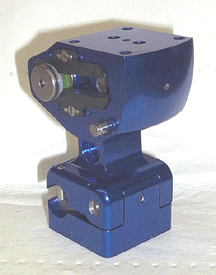
Caption: One version of a modern mechanical polycentric knee is pictured
here. It weighs 1.37 pounds and is 4.12 inches high.

Technical contact:
Mort Lieberman
mlliebe@sandia.gov
505/844-5458
http://www.sandia.gov/media/NewsRel/NR1999/knee.htm
http://news.24.com/English/Sci-Tech_News/Technology/ENG_90818_540391_SEO.asp
http://www.newswise.com/articles/1999/7/KNEE.SNL.html
http://www.owwco.com/Pressre2.pdf
http://www.owwco.com/
http://hightechcareers.com/doc898/devices898.html
http://www.sandia.gov/LabNews/LN11-07-97/foot_story.html
http://www.sandia.gov/LabNews/LN11-07-97/foot_pix.html


                     | Home | Previous | Contents |  Next|