                      | Home | Previous | Contents | Next |


The blind get lift from Java-based design
EE Times - 08/02/99 - Page 87
by Terry Costlow

Heightened awareness, tight job markets and government action are combining
to make it simpler for the blind and visually impaired to work with
computers. Several companies are taking advantage of Java's portability, and
its design for accessibility, to let visually impaired people use different
types of machines.

Almost from the beginning, Sun Microsystems Inc. put in hooks for those who
are designing screen readers and other products that help the disabled
interact with Java-based products. Now, operations as diverse as giant IBM,
tiny Henter-Joyce Inc. (St. Petersburg, FL) and television's Corporation for
Public Broadcasting (CPB) are using Java to make their programs usable by
those who can't easily read the screens.

"Java is very attractive for accessibility because of the work done by Sun
and IBM," said Tom Wlodkowski, project manager at CPB/WGBH National Center
for Accessible Media (NCAM).

"Java programs will run on Windows and on the Macintosh, which is important
to us because lots of schools run Macs," Wlodkowski explained. "If we do the
accessibility work in either of those platforms, it stays on that platform.
With Java, users can go from their classroom, where they work on a Mac, and
go home and continue working on Windows."

NCAM is also working on techniques that will make it easier for programmers
to integrate multimedia CDs with screen readers. Companies that make these
readers, which use voice synthesis to tell blind operators what's being
displayed, are attracted to Java for the same reasons as those with other
programs.

"Java applets are very extensively used in Web developments," said Andres
Gonzalez, software developer at Henter-Joyce. Like roughly half of the 60
employees there, Gonzalez is blind. "We definitely want to provide access to
Web pages," he said. "The number of standalone Java applications is also
growing rapidly. There are a certain number of large corporations that are
using custom Java applications, and they have blind employees who need to
work with them."

Screen readers can be used with Braille products, even replacing them in some
instances. Like Henter-Joyce, many companies will continue to support
Braille, providing a piece of hardware that sits near the keyboard and pops
up pins that create Braille characters as the user types.

Companies are starting to recognize that blind and visually impaired people
are a way to find skilled workers in a tight job market. But their efforts
are being dwarfed by quick action within government agencies driven by
Section 508 of the Federal Rehabilitation Act, which was reissued last fall,
many vendors say. It requires federal agencies buying electronic products to
purchase gear that can be accessed by anyone.

Efforts in these various areas are improving the goal of making nearly all
software accessible to anyone who wants it. The National Science Foundation
is funding an effort to make data on CDs easier to link to screen readers and
other products.

Today's multimedia products, said NCAM’s Wlodkowski "are very rich
graphically, but screen readers can’t work with graphics done with bit maps."
The National Science Foundation wanted guidelines, he said, that let software
developers equally include sighted and blind people. "Our project makes it
relatively easy to wire in access."

WGBH-TV, a leading public-broadcasting station, has been in the vanguard on
accessibility issues for decades. In the early '70s, engineers at the Boston
station were pioneers in closed captioning, using the second audio program in
a novel way. They also made it possible to insert descriptions of the action
during the natural pauses in dialogue. In 1993, NCAM was formed to formalize
such efforts.

While developing programs for the blind has some unique challenges, there are
many similarities in the way that work progresses. As with most projects,
deadlines and adrenaline often combine to help keep the developers revved.

"When we were getting ready to show our first demonstration of Jaws for
Windows with Java, it wasn't reading well based on information it was getting
from the accessibility bridge," Gonzalez said. "Our people were headed to the
conference and we were still here working on fixes. It was just at the last
minute, the night before the demo, that we came up with a solution."

Many companies that specialize in designing for the handicapped like Java
because it has an accessibility bridge and other features that make it easy
to work with. Input is a big factor.

"In Java, a lot of work has already been done for the keyboard commands,"
Wlodkowski said. "They've also worked with the related images on the screen.

Though developers note that Microsoft has also done much in this arena, Java
is currently hot. Henter-Joyce plans to roll its Java-based technology out
shortly, and IBM is beginning to ship a screen reader based around Java. Sun
is making a real effort to help shorten time-to-market.

"Fortunately, Sun has been open and we've been able to get in on the ground
floor so they can take our needs into account," said Wilson Craig, marketing
manager at Henter-Joyce. "Sun has been proactive in accessibility, doing
things like providing us access to their bridge. They are very receptive to
providing us with any information they have."

Nor is the Sun team that added accessibility to Java resting on its laurels.
Members are tweaking other versions of Java to match accessibility features
to those markets. They're also working with Jini, again getting in on the
ground floor with the high-level technology unveiled late last year.

"We initially focused on what accessibility ought to be with the desktop
environment, but Java is much more than the desktop, it includes set-top
boxes, smart phones, and other products" said Earl Johnson, project manager
at Sun (Mountain View, CA). "Now we're extending Jini, which lets people
carry their accessibility profile. Say you're at the Smithsonian, Jini lets a
person who can't see enjoy the exhibit."
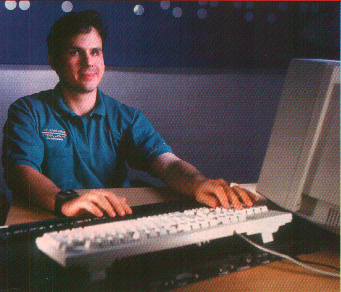
Caption: As he works on screen readers that help the visually impaired,
software developer Andres Gonzalez, who is blind, uses a Braille keyboard to
double-check his typing. His employer, Henter-Joyce, joins IBM and others in
preparing Java-based products to open computing to the disabled.


                     | Home | Previous | Contents | Next |